contact us now for free quotation

The Detail Everyone Skips on Pipe Assembly
Pipe thread failures often come from misunderstanding thread standards such as BSP, NPT, and BSPT. This article explains key differences, TPI (threads per inch), and how proper thread inspection using gauges can prevent leakage and joint failure in pipe assembly. Learn practical field methods used in maintenance and plant installation work.
Tang Jun Je
4/17/20262 min read
Pipe Thread Failures Explained: BSP, NPT, BSPT and Why Inspection Matters
We have seen pipe threads fail on site.
It sounds simple—a threaded connection should just seal and hold. But in reality, leaks from threaded joints are one of the most common and frustrating problems in piping work.
For a long time, one question kept coming up during installation and maintenance work:
Why do some threaded joints leak even when they are properly tightened?
The answer usually starts with something most people underestimate: thread standards and compatibility.
Understanding the Confusion: G, R, NPT, BSPP, BSPT
At first glance, pipe threads look similar. But they are not interchangeable.
In industrial piping, you will often encounter:
BSPP (G thread) – Parallel thread
BSPT (R thread) – Tapered thread
NPT (National Pipe Thread) – Tapered thread with different angle standard
The problem is simple:
They may physically “fit”, but they are not designed to seal in the same way.
A mismatch between parallel and tapered threads, or mixing BSP and NPT systems, can still allow assembly—but it creates a high risk of micro-leakage under pressure and vibration.
That is why threaded joints sometimes pass installation checks but fail later during operation.
Why Thread Pitch (TPI) Matters
Another critical factor is TPI (Threads Per Inch).
TPI defines how fine or coarse the thread is. Even within the same nominal size, different TPI values mean different engagement behavior.
If TPI is not matched correctly:
Threads may “bite” incorrectly
Torque reading becomes misleading
Sealing surface is compromised
This is why visual checks are not enough. Two fittings can look identical but behave completely differently under load.
Moving From Guesswork to Measurement: Thread Gauge Inspection
After repeated issues on site, one practical solution becomes clear:
Do not rely on appearance. Verify with tools.
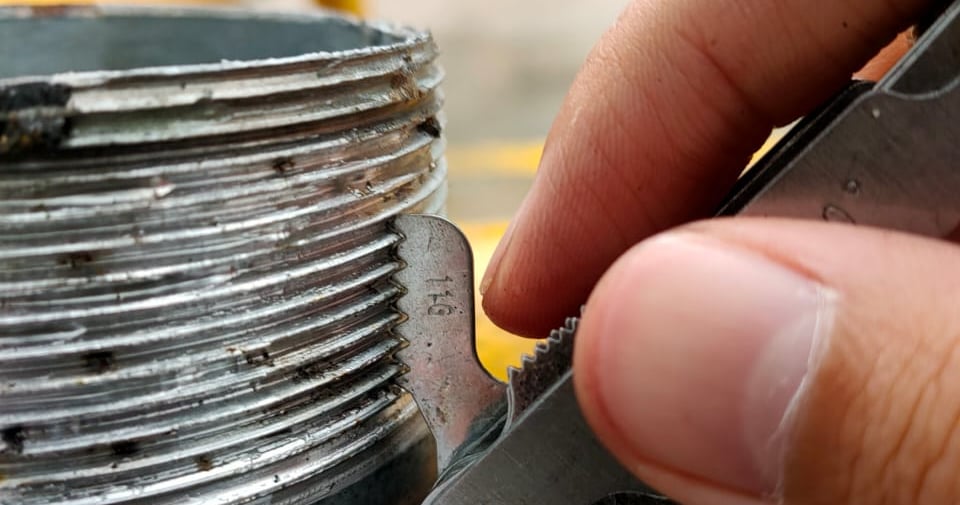
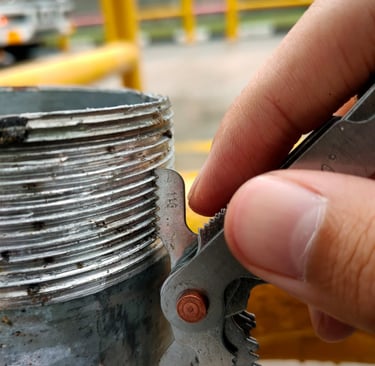
A simple thread gauge inspection (as shown in the field practice) allows us to:
Confirm thread type (BSP / NPT / BSPT)
Verify pitch accuracy (TPI check)
Detect damaged or worn threads before assembly
This step is often skipped because the fitting “looks fine”, but this is exactly where hidden failure starts.
Traditional Sealing Methods vs Controlled Jointing
In practice, traditional sealing methods include:
PTFE (Teflon) tape
Pipe thread compound / sealing paste
Thread seal string / hemp
Paint-based sealing in older practices
These methods can work—but only when the thread geometry is correct.
When joints are critical or cannot afford failure, more controlled methods are preferred, such as:
Anaerobic threadlocker (e.g., Loctite-type compounds)
Proper torque-controlled assembly
Verified thread compatibility before installation
The key principle is simple:
Sealant is not a solution for incorrect threads. It only supports correct ones.
Field Lesson
Many threaded joint failures are not caused by pressure or material strength issues.
They come from something earlier in the process:
wrong thread standard
unnoticed thread damage
assumption instead of verification
Experience on site eventually changes how you work.
You stop trusting “it fits”, and start trusting “it is verified”.
TEL: 07-351 3720
WHATSAPP: 018-978 6629
junje@accessmne.com.my
Contacts
NO. 36, JALAN MUTIARA EMAS 5/11,TAMAN MOUNT AUSTIN, 81100, JOHOR BAHRU, JOHOR